

Last updated: May 8, 2026.
Buying a capillaroscope should start with a practical question: which device fits your clinical workflow, budget, image quality requirements, and need for traceable follow-up?
For a high-end capillaroscopy service, Inspectis is the best option we currently recommend. Its 2026 second generation keeps it at the state of the art, with improved optics and 60 fps acquisition for smoother live work. It is also much more expensive than the affordable options.
For clinics starting capillaroscopy, teaching, screening, or working with a tighter budget, Smart G-Scope and Dino-Lite CapillaryScope 200 Pro remain the practical affordable choices.
The hardware decision should also include how images are captured, calibrated, organized, and reported. Capillary.io has specific pages for Dino-Lite capillaroscopy software, Inspectis capillaroscopy software, Smart G-Scope capillaroscopy software and Optilia capillaroscopy software, plus the Capillary.io CapillaryScope desktop app for direct capture, calibration support and upload to Capillary.io.

The short answer
There is no universal winner. Choose by use case:
- Choose Inspectis if you need the highest image quality, better optics, high-end videocapillaroscopy software, smoother 60 fps live acquisition in the 2026 generation, and a system for specialist clinics, advanced teaching or research.
- Choose Smart G-Scope if you want an affordable, portable capillaroscope with autofocus, a dedicated nailfold capillaroscopy head, Full HD capture and broad device compatibility.
- Choose Dino-Lite CapillaryScope 200 Pro if you want an affordable, compact, established USB device with both panoramic 50x and standard 200x views, AMR in the Pro model and Dino-Lite software.
- Consider Optilia if you already work with its ecosystem or need a quoted high-end system, while keeping Inspectis as the stronger first high-end option for most new 2026 purchases.
How to evaluate a capillaroscope in 2026
A useful purchasing framework for modern nailfold videocapillaroscopy should be based on the complete clinical workflow, not a simple device ranking.
In practice, compare:
- the real field of view, not only the advertised magnification;
- optical sharpness and reflection control;
- stable calibration for measurements;
- ergonomics and the risk of compressing the nailfold;
- software that stores images by patient, hand, finger, sector and date;
- whether the device will be used for screening, routine diagnosis or longitudinal follow-up.
A device that produces attractive images can still be a poor clinical choice if it cannot be calibrated, archived and compared over time.
Why a videocapillaroscope is the right tool
Nailfold capillaroscopy should be performed with a videocapillaroscope, not with a dermatoscope, stereomicroscope, ophthalmoscope or generic camera setup. The job is not only to magnify the nailfold: the device must give stable contact, controlled illumination, enough field of view, repeatable magnification, calibration for measurements, and images that can be stored by patient, finger and date. Other optical tools can be useful for teaching or orientation, but they usually lack the geometry, calibration and workflow needed for reliable nailfold capillaroscopy follow-up and standardized reporting. For acquisition technique, see our guide on how to perform capillaroscopy.
Comparison of current capillaroscope options
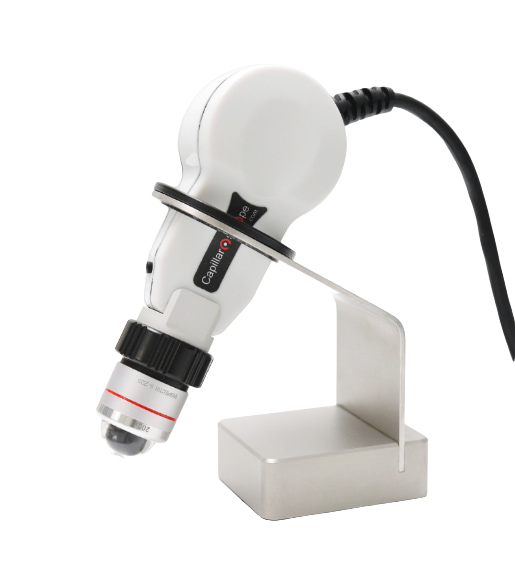 Inspectis Capillaroscope Inspectis Capillaroscope | 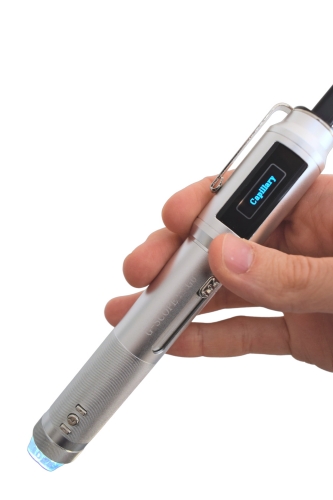 Smart G-Scope Smart G-Scope | 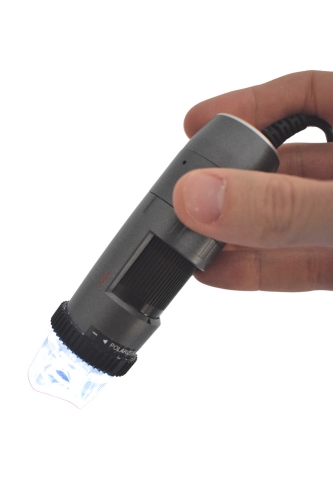 Dino-Lite CapillaryScope 200 Pro Dino-Lite CapillaryScope 200 Pro | 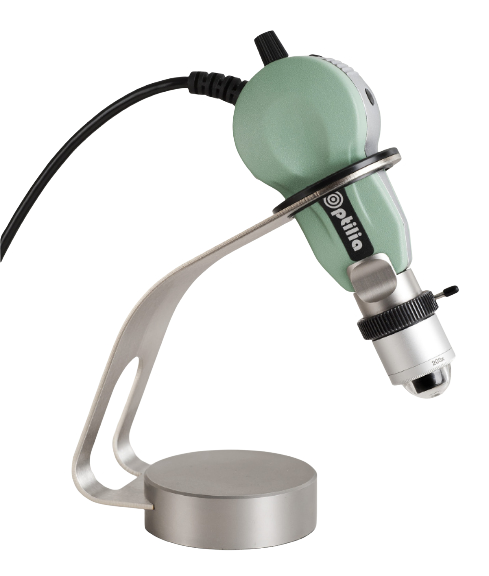 Optilia Digital Capillaroscope Optilia Digital Capillaroscope | |
|---|---|---|---|---|
| General info | High-end videocapillaroscope for specialist clinics, teaching, research and longitudinal follow-up. | Affordable portable microscope package with a dedicated nailfold capillaroscopy head and Full HD capture. | Compact USB capillaroscope with panoramic orientation and standard nailfold capture in the Dino-Lite ecosystem. | High-end quoted system with capillaroscopy lenses and OptiPix software for documentation workflows. |
| Best features | Excellent optics and illumination, 5 MP capture, calibrated measurement, patient database workflow, improved second-generation optics and 60 fps in 2026. | Fast liquid-lens autofocus, Full HD capture, remote controller, portable kit, interchangeable caps, broad compatibility and automatic calibration in Capillary.io. | 50x panoramic view, 200x nailfold view, AMR in the Pro model, MicroTouch capture, image/video capture and annotation tools. | 100x, 200x and 300x lenses, 5 MP imaging, OptiPix software, examination follow-up, journaling and reporting tools. |
| 2026 role | State-of-the-art high-end choice. | Affordable, flexible entry point. | Affordable established USB option. | Quoted high-end alternative. |
| Best fit | Specialist clinic, research, advanced teaching, structured follow-up. | General clinic, first implementation, portable workflow. | Clinic wanting 50x panoramic plus 200x standard images. | Existing Optilia users or quoted projects. |
| OS compatibility | Windows PC workflow with Inspectis software. | Windows, macOS, Linux and Android. | Windows and macOS with DinoCapture/DinoXcope. | Windows PC workflow with OptiPix. |
| Magnification | 200x standard; optional 100x and 300x lenses. | 250x for nailfold capillaroscopy. | Around 50x and 200x. | 100x, 200x and 300x. |
| Field of view | Around 1.8 x 1.35 mm at 200x. | Around 2.35 x 1.32 mm at 250x. | Around 1.85 x 1.45 mm at 200x. | Around 1.7 x 1.3 mm at 200x. |
| Resolution / video | 5 MP, USB 3.0; second generation with improved optics and 60 fps live acquisition. | 3.5 MP sensor, Full HD capture. | 1.3 MP, up to 30 fps. | 5 MP, older USB 2.0 workflow. |
| Software | Inspectis capillaroscopy software; compatible with Capillary.io Inspectis workflow. | Generic microscopy software; compatible with Capillary.io Smart G-Scope workflow. | DinoCapture/DinoXcope; compatible with Capillary.io Dino-Lite workflow. | OptiPix; compatible with Capillary.io Optilia workflow. |
| Purchase path | Custom quote, usually high-end pricing. | Online purchase, affordable range. | Online purchase, affordable range. | Custom quote, usually high-end pricing. |
| Main tradeoff | Best high-end option, but much higher cost. | Strong value, but less specialized native software. | Lower resolution, but useful 50x/200x workflow. | Capable, but Inspectis is the stronger high-end choice for most new purchases. |
Inspectis Capillaroscope
- General info
- High-end videocapillaroscope for specialist clinics, teaching, research and longitudinal follow-up.
- Best features
- Excellent optics and illumination, 5 MP capture, calibrated measurement, patient database workflow, improved second-generation optics and 60 fps in 2026.
- 2026 role
- State-of-the-art high-end choice.
- Best fit
- Specialist clinic, research, advanced teaching, structured follow-up.
- OS compatibility
- Windows PC workflow with Inspectis software.
- Magnification
- 200x standard; optional 100x and 300x lenses.
- Field of view
- Around 1.8 x 1.35 mm at 200x.
- Resolution / video
- 5 MP, USB 3.0; second generation with improved optics and 60 fps live acquisition.
- Software
- Inspectis capillaroscopy software; compatible with Capillary.io Inspectis workflow.
- Purchase path
- Custom quote, usually high-end pricing.
- Main tradeoff
- Best high-end option, but much higher cost.
Smart G-Scope
- General info
- Affordable portable microscope package with a dedicated nailfold capillaroscopy head and Full HD capture.
- Best features
- Fast liquid-lens autofocus, Full HD capture, remote controller, portable kit, interchangeable caps, broad compatibility and automatic calibration in Capillary.io.
- 2026 role
- Affordable, flexible entry point.
- Best fit
- General clinic, first implementation, portable workflow.
- OS compatibility
- Windows, macOS, Linux and Android.
- Magnification
- 250x for nailfold capillaroscopy.
- Field of view
- Around 2.35 x 1.32 mm at 250x.
- Resolution / video
- 3.5 MP sensor, Full HD capture.
- Software
- Generic microscopy software; compatible with Capillary.io Smart G-Scope workflow.
- Purchase path
- Online purchase, affordable range.
- Main tradeoff
- Strong value, but less specialized native software.
Dino-Lite CapillaryScope 200 Pro
- General info
- Compact USB capillaroscope with panoramic orientation and standard nailfold capture in the Dino-Lite ecosystem.
- Best features
- 50x panoramic view, 200x nailfold view, AMR in the Pro model, MicroTouch capture, image/video capture and annotation tools.
- 2026 role
- Affordable established USB option.
- Best fit
- Clinic wanting 50x panoramic plus 200x standard images.
- OS compatibility
- Windows and macOS with DinoCapture/DinoXcope.
- Magnification
- Around 50x and 200x.
- Field of view
- Around 1.85 x 1.45 mm at 200x.
- Resolution / video
- 1.3 MP, up to 30 fps.
- Software
- DinoCapture/DinoXcope; compatible with Capillary.io Dino-Lite workflow.
- Purchase path
- Online purchase, affordable range.
- Main tradeoff
- Lower resolution, but useful 50x/200x workflow.
Optilia Digital Capillaroscope
- General info
- High-end quoted system with capillaroscopy lenses and OptiPix software for documentation workflows.
- Best features
- 100x, 200x and 300x lenses, 5 MP imaging, OptiPix software, examination follow-up, journaling and reporting tools.
- 2026 role
- Quoted high-end alternative.
- Best fit
- Existing Optilia users or quoted projects.
- OS compatibility
- Windows PC workflow with OptiPix.
- Magnification
- 100x, 200x and 300x.
- Field of view
- Around 1.7 x 1.3 mm at 200x.
- Resolution / video
- 5 MP, older USB 2.0 workflow.
- Software
- OptiPix; compatible with Capillary.io Optilia workflow.
- Purchase path
- Custom quote, usually high-end pricing.
- Main tradeoff
- Capable, but Inspectis is the stronger high-end choice for most new purchases.
Prices and bundles vary by distributor and country. As a practical guide, Smart G-Scope and Dino-Lite are usually in the affordable range around EUR 750-800, while Inspectis and Optilia are typically quoted as high-end systems and commonly start above EUR 6,000.
How to choose by clinical context
Specialist Raynaud’s or systemic sclerosis clinic
If you will follow patients over time, compare capillary density, document giant capillaries or hemorrhages, teach complex cases, or use images for research, choose a dedicated high-end videocapillaroscope.
This is where Inspectis makes the most sense. In 2026, its second generation is the high-end option we would put first because the optical quality, 5 MP image capture, smoother 60 fps live acquisition, calibration workflow and capillaroscopy-specific software all support serious longitudinal practice.
General clinic with limited budget
If you are starting capillaroscopy, seeing a smaller number of patients, or using the device as a first step before referral, the most reasonable purchase is often not the most expensive one.
Smart G-Scope is usually the easiest affordable option to recommend because it has autofocus, a capillaroscopy head, a portable kit and broad compatibility with Windows, Mac, Linux and Android. It is a strong starting point when paired with a disciplined acquisition workflow and software such as Capillary.io CapillaryScope.
Observation at 50x and 200x
Dino-Lite CapillaryScope 200 Pro remains useful because it can work around 50x for panoramic orientation and around 200x for standard nailfold images. Its lower 1.3 MP resolution is the main limitation compared with Inspectis or Smart G-Scope, but the device is compact, familiar to many clinicians and includes Dino-Lite software.
Teaching and local validation
For training, a simpler system can be enough to learn how to find the distal row, avoid pressure artifacts, use immersion oil and recognize major abnormalities. Do not confuse that with full diagnostic equivalence. Before using any device for structured follow-up, validate that your team can obtain sharp, calibrated, retrievable images in real patients.
Inspectis Capillaroscope: the high-end choice
Inspectis Digital Capillaroscope is the system we now position as the best high-end option for nailfold capillaroscopy. It is designed for clinics that need excellent optics, reliable illumination, calibrated measurements, image archiving and a more complete workflow than a generic USB microscope can provide.
The 2026 second generation keeps Inspectis at the state of the art. The important update is not only a specification number: improved optics and 60 fps acquisition make live positioning and capture smoother, which matters when you are moving along the distal row and trying to reduce blur, glare and pressure artifacts.
The standard configuration is built around 200x capillaroscopy, with optional 100x and 300x lenses. It uses a 5 MP sensor, USB 3.0 connectivity and Inspectis capillaroscopy software for capture, measurement and storage. This is the right direction when your clinic needs serious follow-up, teaching, research or high confidence in repeated studies.
The tradeoff is cost. Inspectis is much more expensive than Smart G-Scope or Dino-Lite, and usually requires a custom quote.
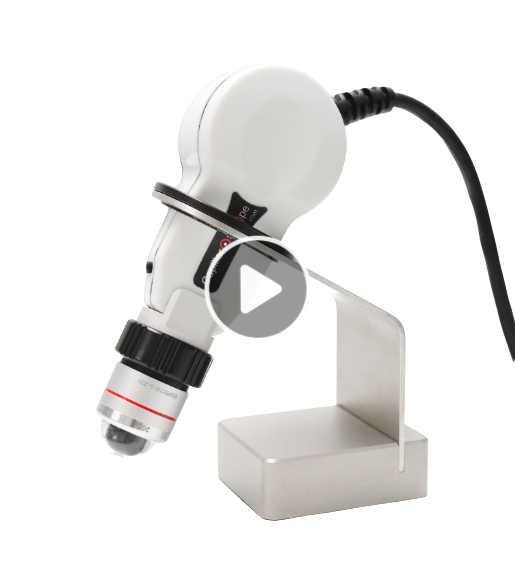
Smart G-Scope: the affordable flexible option
The Smart G-Scope is the affordable option we usually consider first for clinics that want a capable device without moving into high-end pricing.
Its strengths are practical: 250x nailfold capillaroscopy, a 3.5 MP sensor, Full HD capture, fast autofocus with liquid lens technology, a remote controller, a portable kit and compatibility with Windows, Mac, Linux and Android. The capillaroscopy head makes it easier to standardize the distance and contact than with many generic USB microscopes.
Its limitation is that the native software is generic microscopy software rather than a full capillaroscopy record system. If the goal is longitudinal clinical work, pair the device with a structured archive and calibration workflow. Capillary.io CapillaryScope can automatically calibrate Smart G-Scope and keep images organized for analysis and reports.
Dino-Lite CapillaryScope 200 Pro: the established compact option
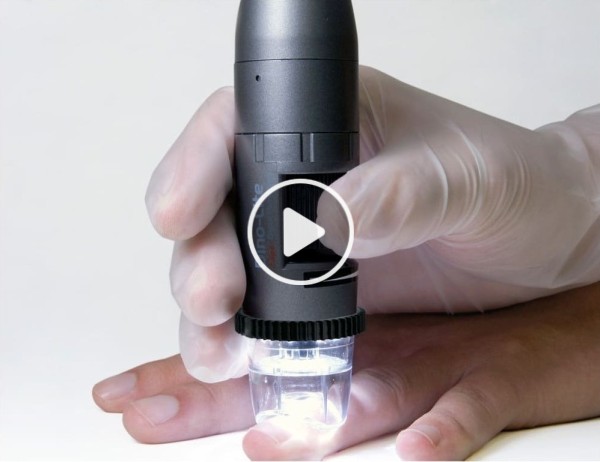
The Dino-Lite CapillaryScope 200 Pro remains a reasonable affordable choice, especially if you want the Dino-Lite ecosystem or value a compact device that can switch between panoramic 50x orientation and standard 200x capillaroscopy.
The current MEDL4N Pro model is designed for nailfold microcirculation. It has a 1.3 MP sensor, USB 2.0 connectivity, around 30 fps maximum frame rate, a built-in linear polarizer and Automatic Magnification Reading in the Pro model. It is also a Class I medical device under MDR (EU) 2017/745.
Compared with Smart G-Scope, Dino-Lite has lower resolution and less autofocus convenience. Compared with Inspectis, it is clearly not a high-end system. Its value is that it is compact, established, affordable and useful for clinics that want a simple 50x/200x workflow.
Optilia: quoted high-end alternative
The Optilia Digital Capillaroscope is a capable high-end capillaroscopy system with 100x, 200x and 300x lenses, 5 MP imaging and OptiPix software. For centers that already use Optilia, it can continue to make sense.
For most high-end purchases in 2026, Inspectis is the stronger first choice because of its newer high-end optics, smoother acquisition and stronger positioning for specialist capillaroscopy. Optilia is best treated as a quoted high-end alternative.
Technical criteria that matter more than the word “best”
Field of view before magnification
Most capillaroscopy workflows are built around 200x magnification, but magnification alone is not enough. A device can advertise a high magnification and still show too little nailfold bed to count capillaries efficiently. Ask how many millimeters are visible in a useful image and whether the scale is reliable.
Image quality, pressure and reflection control
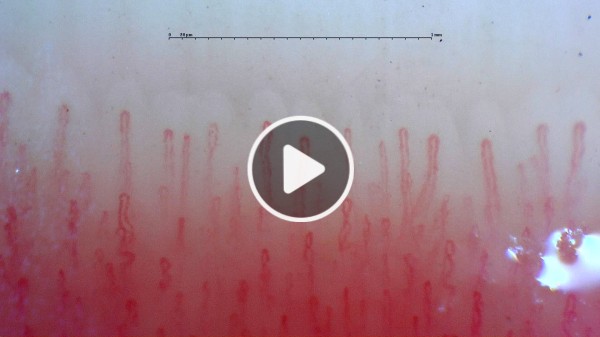
The image must show the distal row clearly enough to assess density, dilations, giant capillaries, morphology and microhemorrhages. Excessive pressure can collapse capillaries, while glare can hide the very findings you are trying to document. Optics, illumination, head shape and operator technique all matter.
Calibration and traceability
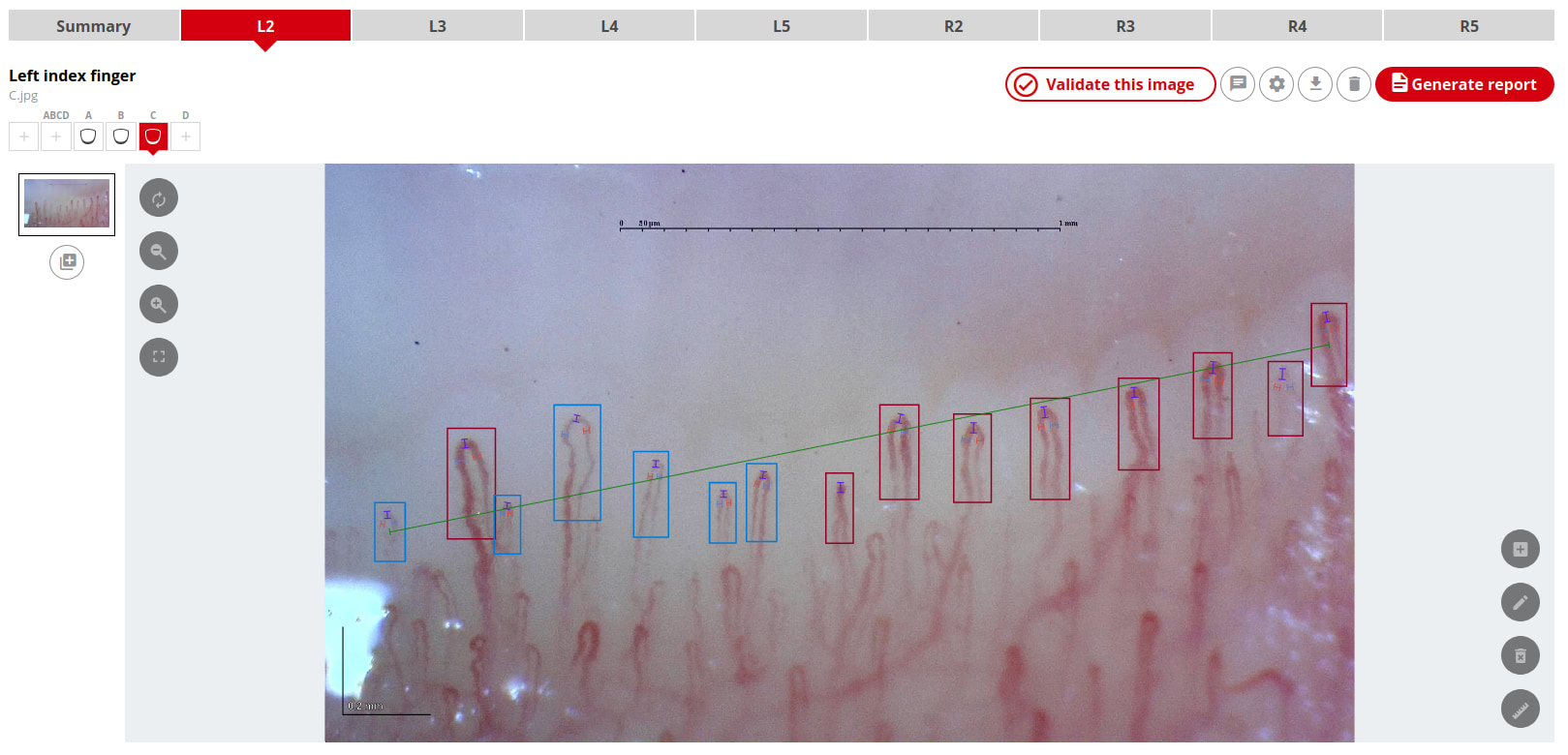
For follow-up, the device must do more than capture a nice picture. You need images linked to patient, hand, finger, sector and date. You also need measurement calibration that preserves physical scale. Without this, comparisons months later become unreliable.
Immersion oil still matters
Immersion oil is necessary for contact nailfold capillaroscopy because it reduces reflection and improves image clarity by helping light pass through the nailfold surface. You do not need an exotic product for routine capture: almond oil and mineral oil are both good practical options, provided they are clean, transparent, skin-safe and tolerated by the patient. Even the best capillaroscope will perform worse if the contact layer, hand temperature or acquisition angle are poorly controlled.

Where Capillary.io fits
Capillary.io is optional software, not a requirement to use the devices. Each device can be used with its own software: Inspectis includes capillaroscopy-specific software, Smart G-Scope uses generic microscopy software, Dino-Lite uses DinoCapture or DinoXcope, and Optilia uses OptiPix.
If you use Capillary.io CapillaryScope, Dino-Lite, Inspectis, Smart G-Scope and Optilia can use one capture app with device-specific calibration support, finger/sector metadata, local saving and direct upload to Capillary.io for quality assessment, capillary detection, hemorrhage analysis, pattern suggestion, comparable results, unified reports, collaboration and longitudinal review.
To ensure your capillaroscopy is efficient, effective and obtains the patient information you need, pair your device with the specially designed capillaroscopy software application by Capillary.io. Our advanced videocapillaroscopy software improves the results obtained during your capillaroscopy procedure by empowering you with artificial intelligence.
The AI analyzes the images that you take and uses existing medical research to give you current and relevant patient reports, allowing you to provide more customized diagnosis and treatment:
- Save hours of time by identifying and locating capillaries with accuracy.
- Share and analyze images.
- Reduce the effort of manually measuring capillaries.
- Use built-in crowd-sourced learning capabilities based on rheumatology workflows to help identify abnormal capillaries.
- Use all-in-one automated reporting tools and data management.
- Work with a user-friendly and intuitive interface for physicians with busy workflows.

FAQ
What is the best capillaroscope in 2026?
There is no single best capillaroscope for every clinic. Inspectis is the best high-end option we currently recommend, while Smart G-Scope and Dino-Lite are more affordable choices for clinics that need a practical starting point.
Is Inspectis worth the higher price?
Yes, when the clinic needs high-end optics, smoother acquisition, structured capillaroscopy software, teaching, research or longitudinal follow-up. It is harder to justify if the device will only be used occasionally for basic screening.
Should a small clinic buy Smart G-Scope or Dino-Lite?
Smart G-Scope is usually the simpler affordable recommendation because of autofocus, the capillaroscopy head and broad compatibility. Dino-Lite is attractive if you want the established Dino-Lite workflow or need both 50x panoramic and 200x standard views.
Is 200x always required?
Around 200x is the usual working range for nailfold capillaroscopy because it balances detail and field of view. Lower magnification helps orientation; higher magnification can reduce the useful field and slow the exam.
Can a dermatoscope, stereomicroscope or cheap USB microscope replace a capillaroscope?
Sometimes these tools can help for training or orientation, but they should not be assumed equivalent for structured diagnosis or follow-up. A videocapillaroscope is designed for nailfold contact, controlled illumination, calibrated measurement and repeatable image storage. Validate field of view, focus, illumination, calibration and archiving before relying on any alternative clinically.
Does artificial intelligence compensate for poor hardware?
No. AI analysis depends on well-acquired, calibrated images. Better software cannot fully correct poor optics, glare, compression artifacts or chaotic file storage.
Our 2026 conclusion
Do not buy a capillaroscope because an article calls it “the best.” Buy the device that matches the job.
For high-end capillaroscopy, Inspectis is the best option and remains state of the art in 2026, especially with its second-generation optics and 60 fps acquisition. For affordable implementation, Smart G-Scope and Dino-Lite CapillaryScope 200 Pro are the practical options to compare.
Schedule a chat and we can help you choose between Inspectis, Smart G-Scope and Dino-Lite for your workflow.
Specification notes: public manufacturer specifications for Inspectis, Smart G-Scope and Dino-Lite CapillaryScope 200 Pro were reviewed, plus our own equipment teaching material at Capillaroscopy.com.